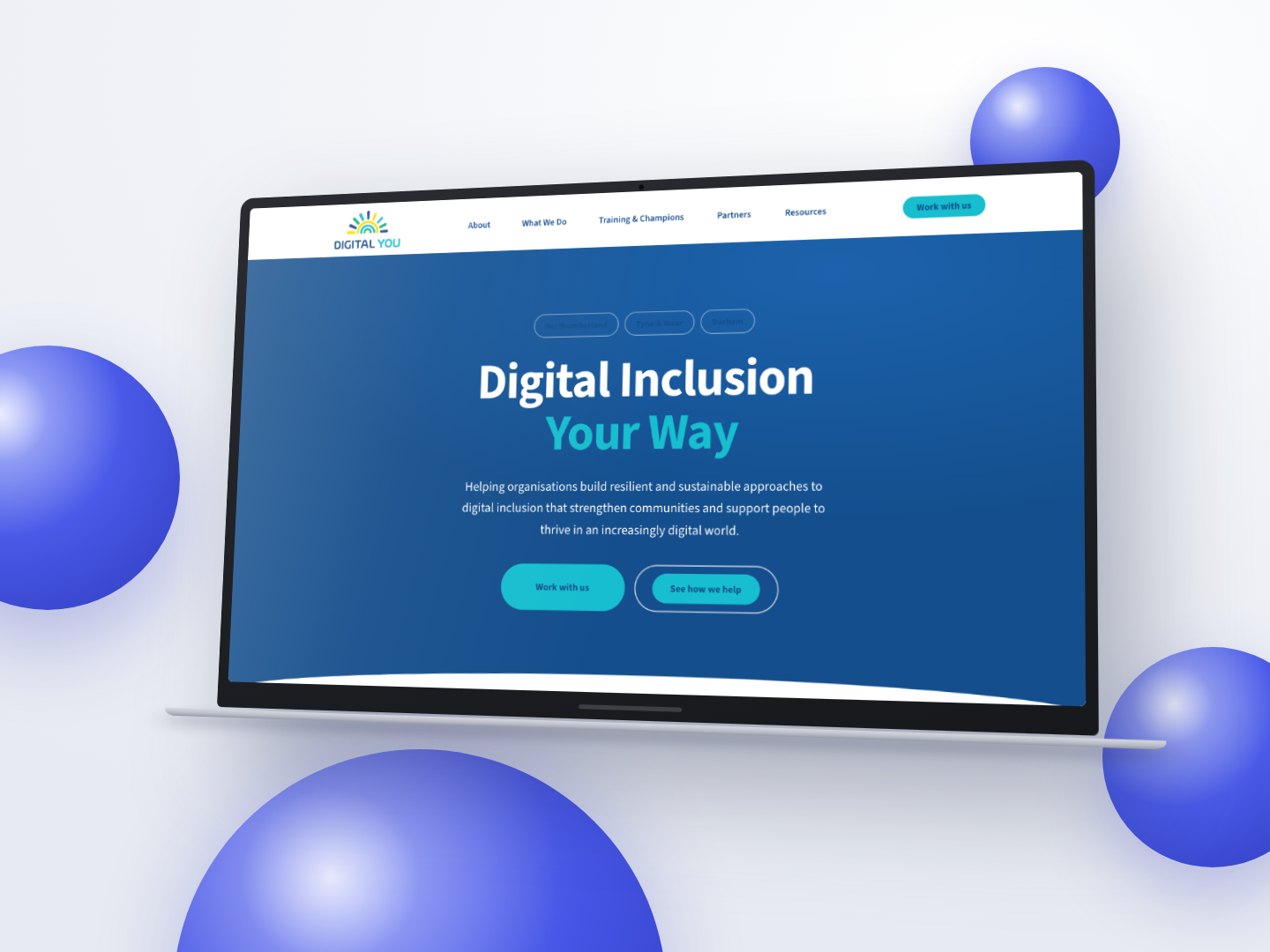
A computer screen with a blue background and the words Digital Inclusion Your Way.
Clients:

Digital You CIC

Category:

Website Design

Link:

See The Result

Digital You CIC — Website Design for a Digital Inclusion Organisation

Client: Digital You CIC · Sector: Digital Inclusion (Community Interest Company) · Location: North East England

1 | Brief

Digital You CIC, run by Sharon Sanders, supports digital inclusion across the North East. Its partners span the voluntary sector, local councils, the NHS, GP practices and housing associations. That range of relationships means credibility matters enormously, so the site had to do two things at once: work as a clear, accessible public-facing presence and hold up as evidence of a functioning organisation when it sits behind a funding application.

A new CIC can't afford a site that looks like a placeholder or makes claims it can't back up. Every word needed to be accurate, every policy page needed to be in place, and cookie consent had to be handled correctly given the NHS and public-sector context. The brief was a fixed-scope build covering the full remit of the organisation, followed by an ongoing monthly care plan.

Because sign-off on some content and images was still in progress during the build, the site was kept behind a holding page throughout. The structure, design and technical work were completed and reviewable; the site deploys once the remaining approvals are done.

2 | Key Goals

  • Give a brand-new CIC a professional, credible website it can point funders and partners to with confidence.
  • Explain digital inclusion work clearly for an audience that may have low digital confidence itself.
  • Cover the full organisational remit: who they are, what they do, training, digital champions, partners, resources and contact.
  • Keep the site accessible throughout, with keyboard-friendly navigation and a dedicated accessibility layer.
  • Handle cookie consent correctly for a public-sector audience, including Google consent mode verified across multiple session states.
  • Keep every claim on the site accurate and verifiable, because inaccurate copy in a grant-application context is a real problem, not just a polish issue.

3 | Solution Snapshot

Problem Solution Implemented
A new CIC needed a site credible enough to sit behind grant applications from day one. Built a 12-page WordPress site covering who they are, what they do, digital inclusion support, training, digital champions, partners, resources, contact, required policy pages, a blog and a custom 404 page.
Page-builder sites are hard to version-control and prone to styles leaking between pages. Pages were authored using scripts that write the Elementor layout data directly. Custom styling lives in versioned mu-plugins scoped per page, so nothing bleeds across the site.
In an NHS and vulnerable-people context, unverified claims carry real risk. Every unverified claim was tracked rather than published. Placeholder photos were marked as placeholders and an unconfirmed job title was flagged in an audit so it could be corrected before launch.
Consent handling had to be correct for a public-sector audience, not just functional. Google consent mode was tested with an automated browser across three fresh session states: no interaction, deny all and accept all. Analytics cookies only appeared after explicit consent.
The audience includes people with low digital confidence who may find complex navigation off-putting. Built with accessibility throughout: a dedicated accessibility layer and native keyboard-friendly navigation are included as standard.
The site needed to be reviewable before every fact and image was signed off. Kept behind a holding page so the completed structure could be reviewed and approved in full before going public, without rushing sign-off on content or image licensing.

4 | Impact

  • A 12-page WordPress site built on the Hello Elementor theme with Elementor Pro, covering the full scope agreed at the outset.
  • Pages authored via scripts that write Elementor layout data, keeping the whole build under proper version control rather than relying on a visual editor alone.
  • Per-page styling scoped in mu-plugins, so the site can be maintained and extended without risk of unintended style changes elsewhere.
  • Cookie consent verified across deny and accept-all sessions using an automated browser, giving confidence the implementation is correct before the site goes live in a public-sector context.
  • A content accuracy audit completed during the build, with flagged items returned to the client for confirmation rather than published as assumptions.
  • A monthly care plan in place so the site has ongoing support once it launches.
Find out more about website design with Luke

What are you waiting waiting for?

Start Your Project Today
Book a FREE Call
footer shape