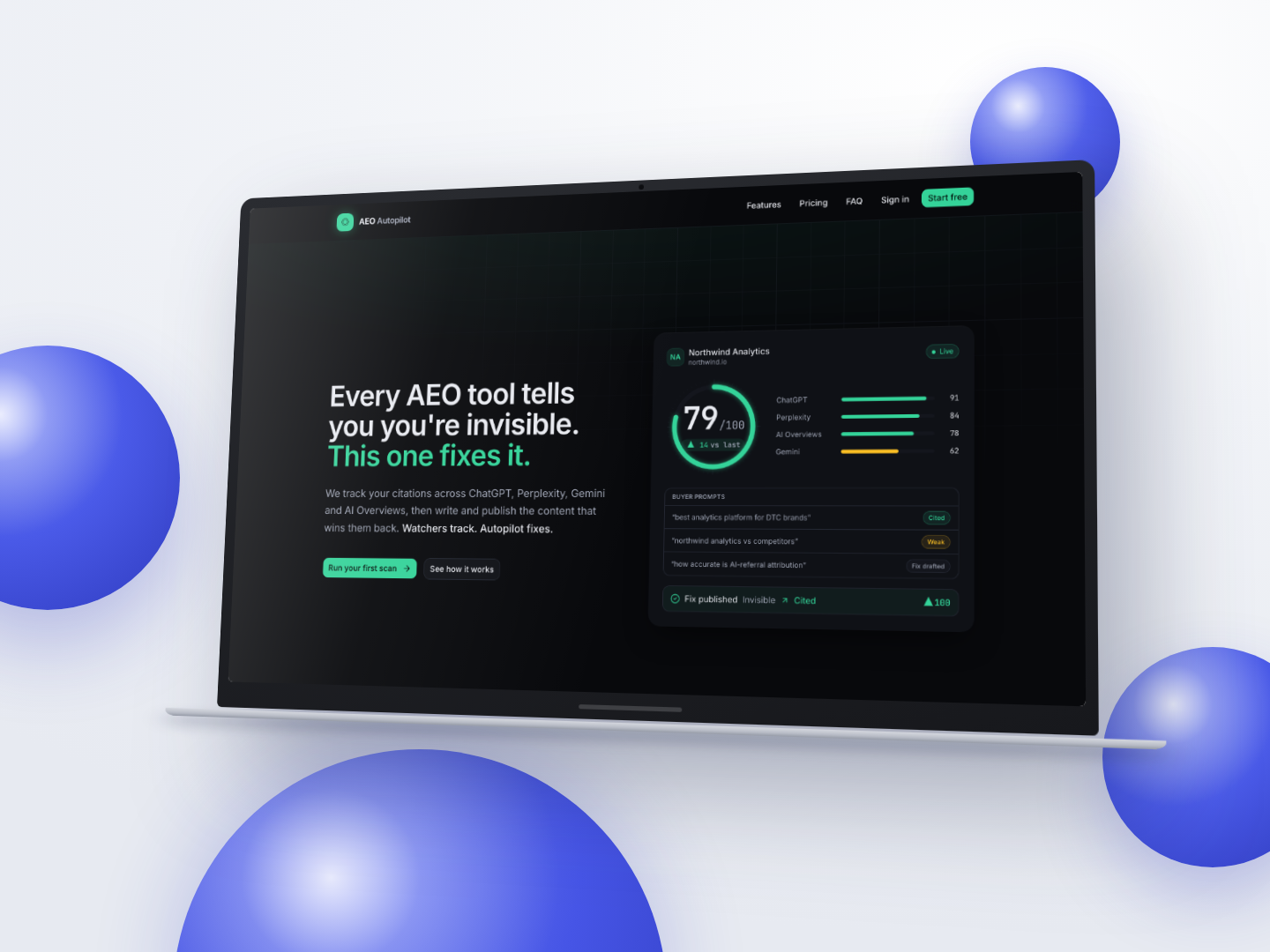
A screen with a message on it that says "Every AEO Tool tells you you're invisible. This one fixes it."
Clients:

lukeduff.co.uk

Category:

Product Design & Build

AEO Autopilot — AI search visibility, tracked and fixed automatically

Client: lukeduff.co.uk · Sector: AI search visibility software · Build type: Own product

1 | Brief

Search behaviour is shifting. A growing share of people ask ChatGPT, Perplexity, Google AI Overviews or Gemini a question and take the answer they get, without clicking through to any website. Brands that used to rely on organic rankings now have a blind spot: they have no way of knowing whether the AI assistants that are replacing those clicks ever mention them at all.

AEO Autopilot is Luke's own product, built to close that gap. It tracks whether a brand is cited when the major AI engines answer the questions that matter to that brand, works out why it is being skipped, writes content to fix the problem, publishes that content directly to the brand's WordPress site, and then re-checks to see whether the fix landed. The loop runs without the customer having to do any of the individual steps themselves.

This is an in-progress product build. The technical foundation is complete, including the tracking layer, the publishing pipeline and the safety mechanisms described below. Database wiring and authentication are still on test keys, so the product is not yet transacting.


2 | Key Goals

  • Track whether a brand is cited across ChatGPT, Google AI Overviews, Perplexity and Gemini for its key questions.
  • Diagnose the reasons a brand is absent from AI-generated answers, rather than just flagging that it is.
  • Generate publish-ready content that addresses those specific gaps.
  • Publish fixes directly to the customer's own WordPress site, not just produce a report for them to action manually.
  • Re-check citations after publishing to confirm whether the fix made a difference.
  • Handle customer WordPress credentials safely, with no route for those credentials to leak to a third-party domain.
  • Keep the tool fully runnable during development without every paid API key in place.

3 | Solution Snapshot

Problem Solution Implemented
Brands have no visibility into whether AI assistants ever mention them. Built a tracking layer that queries the major AI engines for a brand's key questions and records whether the brand was cited in each response.
Most monitoring tools stop at the report and leave the actual work to the customer. Built the complete loop: track, diagnose, generate a fix, publish it to WordPress, and re-check. The tool does the work rather than handing the problem back.
Publishing to a customer's WordPress requires handling their credentials without leaking them. Built a redirect-aware request guard that re-validates every redirect hop and drops the WordPress credential on any cross-origin redirect, closing that leak route at the HTTP layer.
Usage quotas can drift or be double-counted when concurrent background workers are running. Made quota accounting atomic in the database, with a refund path that fires at most once even when two workers race to refund the same job.
Retried background jobs risked creating duplicate citation records. Made citation writes idempotent so a retried job cannot insert a result that already exists.
Development was blocked whenever a paid API key was missing. Built deterministic fallbacks across the engine layer so the full pipeline runs end to end with no keys wired up, and upgrades to the live paid services automatically when keys are present.

4 | Impact

  • A multi-tenant Next.js application with background jobs handling both the AI tracking and the WordPress publishing pipeline.
  • A redirect-aware HTTP request guard that strips credentials on cross-origin hops, protecting customer WordPress credentials at the transport level.
  • Atomic quota accounting with a single-fire refund path, keeping usage figures consistent under concurrent load.
  • Idempotent citation writes that make the background jobs safe to retry without producing duplicate data.
  • A deterministic fallback layer that lets the entire engine run without any paid API keys during development, then switches to live services when keys are configured.
  • A complete end-to-end pipeline, from citation tracking through diagnosis, content generation, publishing and re-checking, built and ready for the remaining database and auth work that will open it to users.
Get in touch about this project

What are you waiting waiting for?

Start Your Project Today
Book a FREE Call
footer shape